
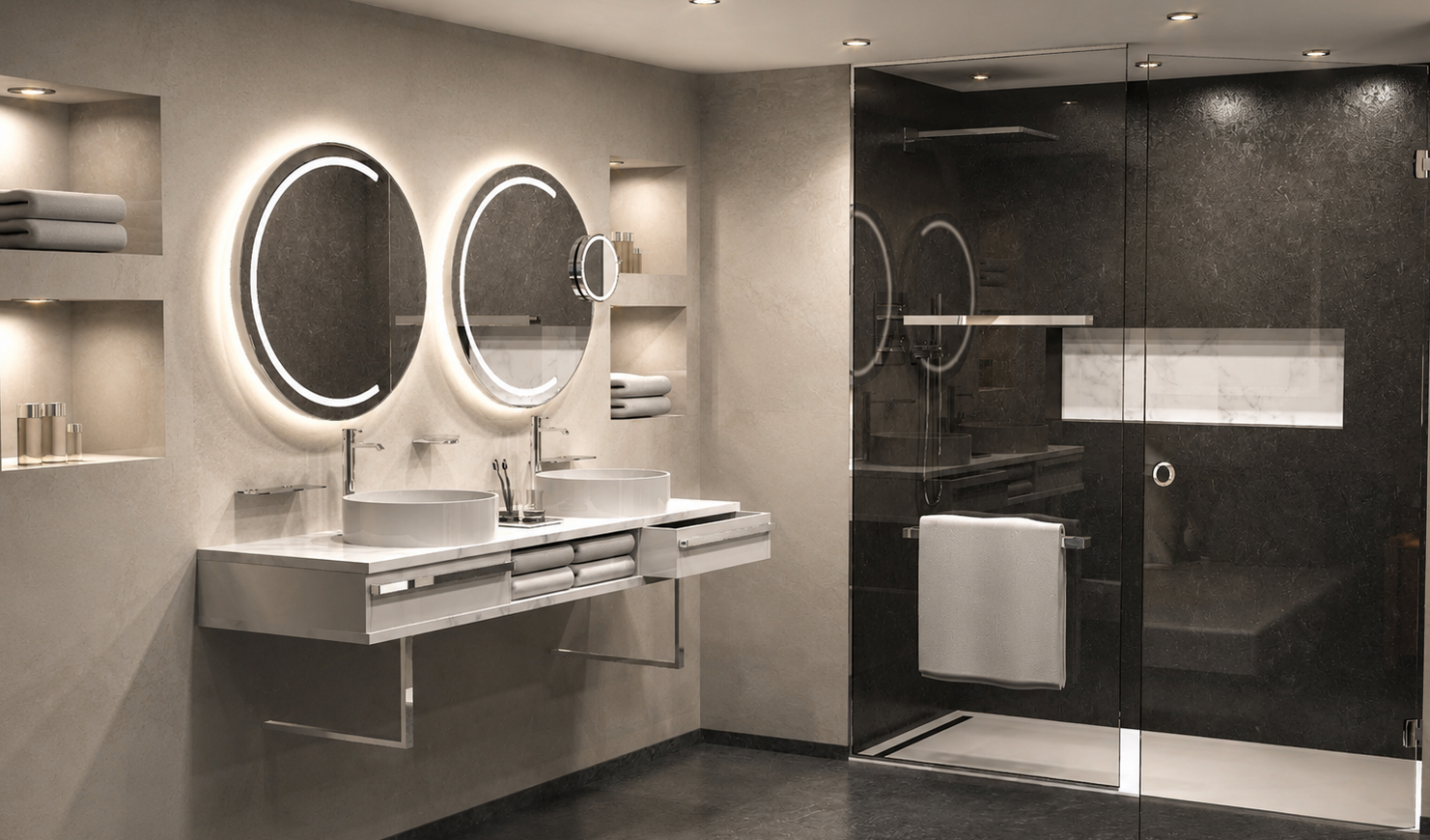
How to clean a chrome-plated brass accessory?
The easiest way to remove everyday marks from a chrome-plated brass bathroom accessory is to use a soft cloth or a microfibre cloth.
To preserve the finish, never use products containing acids, ammonia or abrasive substances.
Never use construction cleaning products, as they are too acidic.
Never use abrasive sponges or scouring pads.
Avoid limescale removers.
How to clean and maintain my mirror?
Some simple but important rules to help maximise the lifespan of your mirrors:
1 - In most cases, mirrors can and should be cleaned using a dry microfibre cloth only, without adding any liquid.
2 - For stubborn marks, the microfibre cloth may be lightly dampened with clean water or an alcohol-based cleaner (household alcohol or isopropyl alcohol).
3 - Never spray cleaning products directly onto the mirror. Liquid may run behind the mirror, remain trapped and cause irreversible deterioration of the silver backing (not covered by the warranty).
4 - The edges of the mirror must always be dried thoroughly and promptly. Excessive water, as well as many detergents, may cause a defect commonly known as "black edge" if they remain in contact with the edge of the mirror for too long. To date, no manufacturing process can completely prevent this phenomenon.
5 - Always use an alcohol-based glass cleaner.
6 - When removing solid residues, always clean carefully and avoid applying excessive pressure.
7 - Never use aggressive cleaning tools or products such as razor blades, steel wool, abrasive materials, etc. to clean a mirror.
8 - Never attempt to remove dirt or impurities using a dirty cloth, as trapped particles may scratch the mirror surface. If marks remain, repeat the cleaning process.
9 - Never use products containing hydrofluoric acid or fluorinated, chlorinated or ammoniated compounds (including certain limescale removers), as they may damage either the front or the back of the mirror upon contact.
10 - Never use strongly acidic or alkaline cleaning products, as they may damage or abrade the glass surface.
11 - Never use detergents with a pH of 12, as they may cause corrosion if they come into contact with the rear of the mirror.
Why choose brass for my accessories rather than aluminum or zamak?
Brass is a non-ferrous alloy mainly composed of copper and zinc.
It forms the base material of the accessory, onto which a surface finish, such as chrome plating, is subsequently applied.
Chrome plating consists of a thick nickel layer designed to improve hardness, followed by a chromium layer that provides the final bright finish.
It therefore combines several successive surface treatment processes.
Highly durable and corrosion-resistant, brass does not rust (unlike ferrous metals).
Its density, which is close to that of steel, is approximately three times greater than that of aluminium (8.73 g/cm³ compared with 2.7 g/cm³).
This gives brass greater resistance to impacts and helps prevent tube deformation or twisting compared with aluminium.
As for zamak, it is more brittle than brass and offers lower impact resistance.
For equipment intended for intensive use, such as in the hospitality sector, brass is a more durable and more robust choice.
Finally, brass is fully recyclable.
This property helps reduce energy consumption, as brass can be easily melted down, reshaped and reused while remaining a non-toxic material for the environment.
Chrome-plated aluminium profiles and accessories in humid environments – what should you know?
Applying chrome plating directly to aluminium presents significant risks in terms of long-term durability and warranty performance (as demonstrated by salt spray testing).
To ensure proper adhesion of the chrome finish, the aluminium must first undergo a specific surface treatment, followed by a copper layer that provides a suitable base for the subsequent plating process.
Copper plating aluminium is a complex process whose cost-benefit ratio does not justify its use for this type of application.
Direct contact between aluminium and copper, or any of its alloys (such as brass or bronze), should be avoided, particularly in humid environments.
Such contact may cause severe galvanic corrosion of the aluminium, even if it has been anodised or powder-coated.
This type of assembly should only be considered in permanently dry environments.
Copper salts may also chemically attack aluminium.
As a result, poorly executed or damaged chrome plating (even a simple scratch may be sufficient) can eventually render the product unserviceable.
For this reason, aluminium structures should never be designed in such a way that water can flow over copper before coming into contact with the aluminium.
Likewise, water that has previously flowed over copper (or one of its alloys) may also cause corrosion of the aluminium.
Can safety glass break?
Safety glass (tempered glass) is a safety glazing material strengthened through a thermal tempering process.
The tempering process consists of heating the glass to approximately 650°C, followed by rapid cooling using high-pressure air jets.
This process significantly increases the glass's resistance to impact, thermal shock and bending stresses.
The resulting modification of its molecular structure increases its mechanical strength by approximately seven times.
If breakage does occur, tempered safety glass shatters into thousands of small, relatively blunt fragments, greatly reducing the risk of serious injury compared with standard annealed glass.
For this reason, tempered safety glass is classified as a safety glazing material and is widely used for applications such as shower screens, partitions, kitchen splashbacks and many other architectural glazing systems.
However, in accordance with EN 12150, tempered safety glass may still present a small risk of spontaneous breakage.
This risk can be significantly reduced by means of the Heat Soak Test (HST).
This additional process consists of maintaining the glass at an elevated temperature for several hours in order to eliminate panes containing nickel sulphide inclusions that could later cause spontaneous breakage.
It should be noted that this treatment generally increases the cost by approximately 25 to 40%. In addition, its production cycle is not well suited to high-volume manufacturing where short lead times are required.
Water tightness: understanding the different types of shower screens
Let's be honest: a shower screen is not an aquarium.
It is impossible to eliminate all water splashes or prevent every drop of water from reaching the bathroom floor.
However, the design of the shower screen, its configuration, installation method and a number of technical details all have a direct impact on its level of water tightness.
Today's market offers a wide range of industrially manufactured shower screens.
Most manufacturers develop their products to meet a target price or a specific market segment.
As a result, some solutions are designed primarily to achieve a particular price point, sometimes at the expense of performance or long-term durability.
In some cases, the product may no longer be truly suitable for intensive use, particularly in the hospitality industry.
For hotels, price alone should never be the deciding factor when selecting a shower screen.
Budget is, of course, an important consideration, but it should never be the primary criterion.
It is essential to choose a product that is specifically designed and guaranteed for hotel use.
To do so, the first step is to define your requirements and ask the supplier one simple question:
"Is this shower screen guaranteed for hotel use?"
The answer will naturally help determine which products are best suited to your project.
It becomes even more important if the supplier is also responsible for the installation and for the associated warranties (Defects Liability Period (GPA), biennial warranty and ten-year structural warranty, etc.).
There are two main types of shower screens:
- Semi-framed shower screens:
They offer a good level of water tightness and are easy to maintain thanks to the limited number of aluminium profiles.
Their modern, minimalist design is particularly well suited to contemporary hotel bathrooms.
However, in our experience, they should be manufactured using 8 mm tempered safety glass to ensure sufficient rigidity and long-term durability in a hospitality environment.
- Fully framed shower screens:
They provide optimum water tightness.
On the other hand, depending on the design, they are generally more difficult to clean. Their frame is more robust but also visually heavier, with larger and less discreet profiles.
Spare parts management can also become more complicated, particularly when several parties are involved in supplying the product (plumbing contractor, distributor, manufacturer, etc.).
Should a problem arise, identifying responsibilities and managing the after-sales service can therefore become significantly more complex.
Haccess has chosen to offer a single range of semi-framed shower screens, manufactured from 8 mm tempered safety glass, in order to achieve the best balance between aesthetics, reliability and long-term durability.
The door pivots on solid brass hinges with a chrome-plated finish.
Based on our experience, this is the only solution that enables us to guarantee the level of reliability required for intensive hotel use.
Installation is more technical and requires qualified personnel.
For this reason, our shower screens are supplied exclusively with our installation service.
This complete service allows us to take full responsibility for the project, from product supply through to installation.
A fully framed shower screen will always provide a higher level of water tightness than a semi-framed model.
However, it is generally more difficult to maintain and its long-term reliability can be more challenging to guarantee in a hotel environment.
It incorporates a greater number of connecting components, many of which are made of plastic and are subjected to intensive daily use.
Hot water, temperature fluctuations and repeated mechanical stress accelerate their ageing and increase the risk of failure over time.
This is particularly true for roller mechanisms, pivot systems and other moving parts, all of which represent potential points of failure.
The final choice of a shower screen is therefore always a balance between water tightness, aesthetics, ease of cleaning and long-term maintenance.
In the hospitality industry, maintaining a shower screen can be particularly challenging.
Every repair means taking a room out of service, resulting in lost revenue.
It also means finding a contractor willing to carry out the repair and supply the appropriate spare parts.
Yet this issue is rarely considered when the product is first selected, and very few companies are genuinely organised to provide this type of maintenance service.
This is precisely why we have chosen a hinged door system.
This system provides outstanding reliability and, if necessary, allows a door to be replaced in less than fifteen minutes, without cutting through silicone joints or carrying out any major work.
Its only drawback is the possibility of a very slight water passage if the shower screen is deliberately subjected to an extreme test, for example by directing a handheld shower head continuously at the hinges from a distance of only a few centimetres.
However, any water tightness test should always reflect normal operating conditions.
The formation of puddles outside the shower area is not acceptable. On the other hand, minor water splashes or a few drops on the uprights or on the bathroom floor when opening the door are considered acceptable under normal conditions of use.
A test consisting of directing a continuous water jet at sensitive areas (seals, hinges, pivot points, etc.) for several minutes does not reflect the actual operating conditions of a shower screen.
Under normal conditions of use, water flows vertically from the overhead shower.
Horizontal splashes reaching the glass remain indirect and occur at a sufficient distance from the screen.
During normal use, water is directed towards the user, not towards the outside of the shower.
Once again, a shower screen is not an aquarium and is not designed to retain a permanent volume of water.
Water tightness tests should therefore be carried out with common sense, bearing in mind that a few drops of water may simply result from runoff when opening the door or from the user stepping out of the shower onto the bathroom floor.
Choosing a shower screen is always a matter of finding the right balance.
Price is, of course, an important consideration, but a shower screen should above all be regarded as a long-term investment in guest comfort and the durability of the installation.
For hotel applications, a shower screen must be robust, durable, aesthetically pleasing, easy to clean and simple to maintain.
This is why we have chosen a semi-framed shower screen manufactured from 8 mm tempered safety glass and fitted with solid brass hinges.
Based on our experience, this solution currently offers the best balance between water tightness, aesthetics, reliability, ease of maintenance and long-term durability.
Can a shower screen be installed without a bottom water retainer (threshold)?
Yes, but only at the client's explicit request.
A shower screen may be installed without a bottom water retainer (threshold) on the door.
The client acknowledges having been fully informed that the purpose of the water retainer is to limit water splashes and water leakage outside the shower area, and that its removal may reduce the watertight performance of the installation and result in water splashes or water leakage outside the shower area.
Consequently, this configuration is carried out at the client's sole risk and responsibility.
No claim, contractual warranty, Defects Liability Period (DLP) claim, or request for corrective work shall be accepted in relation to any watertightness issue, water leakage or water splashes resulting from the absence of the water retainer.
If, following the installation of the shower screen, the client wishes to have a water retainer supplied and installed, this work will be subject to a separate quotation.
All costs relating to the supply, travel, labour and, where applicable, any ancillary work shall be borne entirely by the client.